



Hey everyone, if you’ve ever worked with liquid silicone rubber (LSR) parts for medical devices, automotive gaskets, or consumer electronics, you know how critical it is to have the right molder—because not all LSR machines are created equal. As someone who’s been in the LSR molder supplier game for years, I get it: when customers ask, “What are the actual technical specs I need to care about for LSR molders?” I don’t just rattle off a bunch of jargon. I break it down into what matters for your production, quality, and bottom line. Let’s dive into the real specs that make or break LSR molding, no stuffy textbook talk here.
First off, let’s start with the core: LSR is a two-part thermoset material that cures super fast when heated, so your molder’s job is to mix, inject, and cure it without a hitch. The first big spec is injection unit details—specifically, shot size and barrel design. Most people don’t realize that LSR shot size is measured in grams of cured silicone, not just raw material, and it needs to match your part size. If you run a tiny medical seal, you don’t want a molder built for large automotive components wasting material or causing inconsistent shots. A lot of our clients come in thinking they can use any old injection machine, but LSR needs a specific barrel with a low-shear screw—high shear would make the silicone cure prematurely, killing your cycle time. That’s why our TYM-W LSR Injection Molding Machine has a precision barrel that minimizes shear; we’ve seen customers cut scrap rates by 12% just from that single design tweak.
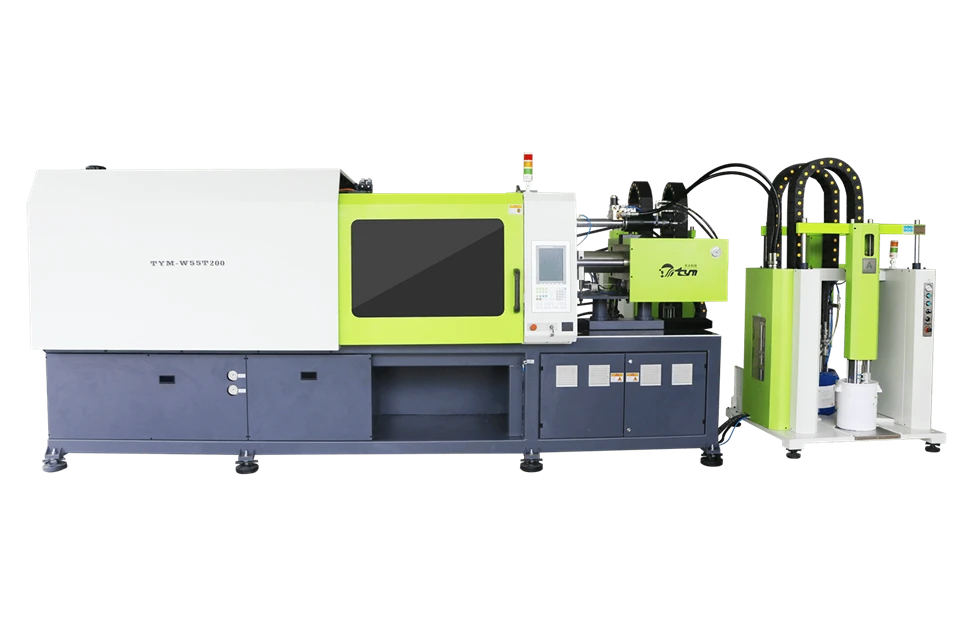

Next up: injection pressure and speed. LSR isn’t like plastic, which you can crank up pressure on if needed. Too much pressure with LSR can flash your parts (thin, unwanted material lines) or damage delicate molds, especially for micro parts. The sweet spot is usually between 500 and 1500 bar, depending on part complexity. Speed matters too—you need to inject LSR fast enough to fill the mold before it starts curing, but not so fast that you cause air bubbles. Our TYM-W Toggle LSR Injection Molding Machine has adjustable injection speed with real-time pressure monitoring, so operators can dial it in for each job without guesswork. For example, a client molding smartphone keypads uses a slower, more controlled injection speed with our toggle machine to get bubble-free parts every time.
Then there’s clamping force—this is non-negotiable. Clamping force is measured in tons, and it’s the pressure that holds the mold shut while you inject LSR. If you don’t have enough clamping force, flash will ruin your parts. If you have too much, you’ll wear out your mold or machine unnecessarily. For small parts like O-rings, you might only need 20-50 tons, but larger parts like silicone keyboard covers or automotive gaskets can need 100+ tons. Our TYM-W55T200 2K / Double-Color Machine is a hit for customers doing overmolding—its 55-ton clamping force is perfect for small to medium double-color LSR parts, and the toggle design on our other models gives consistent clamping across every cycle, no drop-offs that cause flash.
Wait, let’s talk about double-color and 2K molding because that’s a huge segment now—medical devices with soft silicone seals over hard plastic, or multi-material consumer parts. A lot of customers don’t realize that regular LSR molders can’t do 2K because they lack synchronized injection units and clamping rotation. The TYM-W55T200 is built exactly for that: it has two independent injection barrels, a rotating platen that swaps molds between materials, and a control system that syncs injection, clamping, and rotation so you don’t have part alignment issues. We have a customer making dual-material hearing aid tips that cut their cycle time in half with this machine, compared to running two separate single-color machines.
Another spec that’s often overlooked: cure temperature and control. LSR cures at temperatures between 120°C and 180°C, depending on the grade. But consistent temperature across the mold is key—hot spots will cure the material too fast, cold spots will leave it undercured (which makes parts weak or sticky). Most good LSR molders have heated platens with multiple temperature zones, not just a single heater. Our TYM-W machines have up to 12 independent temperature zones, so even for complex molds with thin and thick sections, you get uniform cure. I once had a client running a thick silicone gasket that had consistent cure issues until they switched to our machine with zone control—their undercure scrap went from 8% to less than 1% overnight.
Cycle time is tied directly to cure time, and that’s where material grade and molder specs meet. LSR cure time is usually 30 seconds to 2 minutes, but the machine’s ability to hold temperature steady and inject material fast lets you hit the minimum cure time without defects. A lot of cheaper molders have slow heat-up times, so you waste 5-10 minutes per cycle just waiting for the mold to hit temp. Our TYM-W models heat up in half that time, which adds up to huge production gains for high-volume runs. For a client making 1 million silicone phone cases a month, that extra 5 minutes per cycle meant they needed one less machine line, saving them tens of thousands in upfront cost.
Now, let’s get into controls and automation—because no one wants a machine that requires a specialized operator for every tiny change. Modern LSR molders have PLC controls with touchscreens that let you save part recipes, adjust pressure/speed/temp with a few taps, and monitor cycles in real time. Some even have connectivity for Industry 4.0, so you can track production, catch issues before they cause scrap, and adjust settings remotely. All our TYM-W machines come with a user-friendly control panel—our operators train clients in half a day, not a week, which is a big win for small to mid-sized manufacturers who don’t have a huge tech team.
Wait, let’s not forget material handling—LSR is a two-part system, so you need a mixing unit that keeps the A and B parts in the right ratio (usually 1:1) without premature curing. Bad mixing leads to inconsistent parts, so a positive-displacement mixing system is a must, not just a static mixer. Our machines have precision mixing pumps that maintain ratio within ±0.5%, so even micro parts have the right material properties. We once had a client who was getting part rejections because their old molder’s ratio was off—switching to our TYM-W fixed that immediately.
So when you’re shopping for an LSR molder, don’t just look at the tonnage or shot size. Ask about: injection unit shear, temperature zone control, pressure/speed adjustability, mixing precision, and control system usability. Those are the specs that actually impact your part quality and production efficiency. If you’re working on medical parts, you might also want compatibility with cleanroom environments, which our TYM-W machines are rated for—they have sealed components to keep dust out, so they meet FDA requirements for Class 100,000 cleanrooms.
I get it, navigating LSR mold tech can be overwhelming, but you don’t have to do it alone. We’ve been supplying these machines for over a decade, and we’ve helped everything from startups testing their first part to large automotive brands scaling production. Whether you need a single horizontal machine, a double-color setup, or a toggle-style machine for high-volume runs, we can walk you through the specs that fit your exact needs. No pressure, no sales jargon—just straight talk about what will work for your parts.
If you’re ready to stop dealing with inconsistent LSR parts, high scrap rates, or slow cycle times, reach out to us to talk through your project. We’ll help you pick the right machine, whether that’s our TYM-W, our TYM-W55T200, or our TYM-W Toggle model, and make sure you have everything you need to get production up and running smoothly. Don’t settle for a machine that checks boxes on paper—pick one that’s built for real LSR molding challenges.
References
- Understanding Liquid Silicone Rubber Molding: Key Equipment and Process Specifications. Society of Plastics Engineers, 2022.
- LSR Injection Molding Machine Performance Metrics for High-Volume Production. Journal of Manufacturing Processes, Vol. 48, 2020, pp. 112-121.
- Double-Color LSR Molding: Design Considerations and Machine Capabilities. Medical Device & Diagnostic Industry, 2021.